
Yep, I Make My Own Aloe Vera Juice. Here's Why, What Not To Do + My Recipe
Most people drink aloe vera juice for digestive issues and hydration, but there are so many more benefits. The clear inner gel is water-dense, naturally low in sugar and carries minerals like calcium, potassium and magnesium. It's one of nature's true superfoods. It's great for gut health, early research suggests its prebiotic-style polysaccharides may also support a healthy, diverse gut microbiome, which can have flow-on effects for skin.
But be careful of the yellow latex layer just under the leaf skin. It contains aloin, a strong natural laxative, so any fresh aloe juice needs to be made from the inner gel only. If you are buying store-bought it's already been commercially decolourised, ie. the aloin has been processed out. Aloe vera juice is, in my opinion, the ultimate wellness drink. But it is not a medicine, and it is not for everyone. Avoid it if you are pregnant, breastfeeding, taking certain medications or under 12 years of age. While commercially processed aloe juice is generally considered suitable for children without sensitivities or allergies, experts typically recommend avoiding fresh homemade aloe juice in kids.
Can it cure eczema in 6 weeks? Nope. I don't think so. But that's not to say that it doesn't have some amazing benefits. If you want the full picture, the health benefits of aloe vera, a simple aloe vera juice recipe and how I use aloe on skin, read on.
Why I’m writing this
I’m Jacqui. I founded Salvida, an Aussie skincare brand for sensitive and eczema-prone skin, and I get asked about aloe vera more than almost any other ingredient. It's even the hero ingredient in one of our products, Every Day, Everywhere. Needless to say, I love it. But is it a "holy grail" eczema cure?
Aloe is genuinely lovely on skin and my favourite homemade drink. It's getting a lot of attention at the moment on socials for apparently "curing eczema in 6 weeks", but is it a magic fix or overhyped? I have my own eczema history and I have spent years reading ingredient lists, so I wanted to write an honest opinion piece on this.
If you are new here, two articles pair well with this one: Hydration and Skin Health: Why Drinking Water Isn’t Enough and Best Diet for Eczema: Top Foods to Eat (and Avoid) for Friendly Skin.
What aloe vera juice actually is (and why the latex matters)
An aloe leaf has three layers, and the difference between them is the whole story.
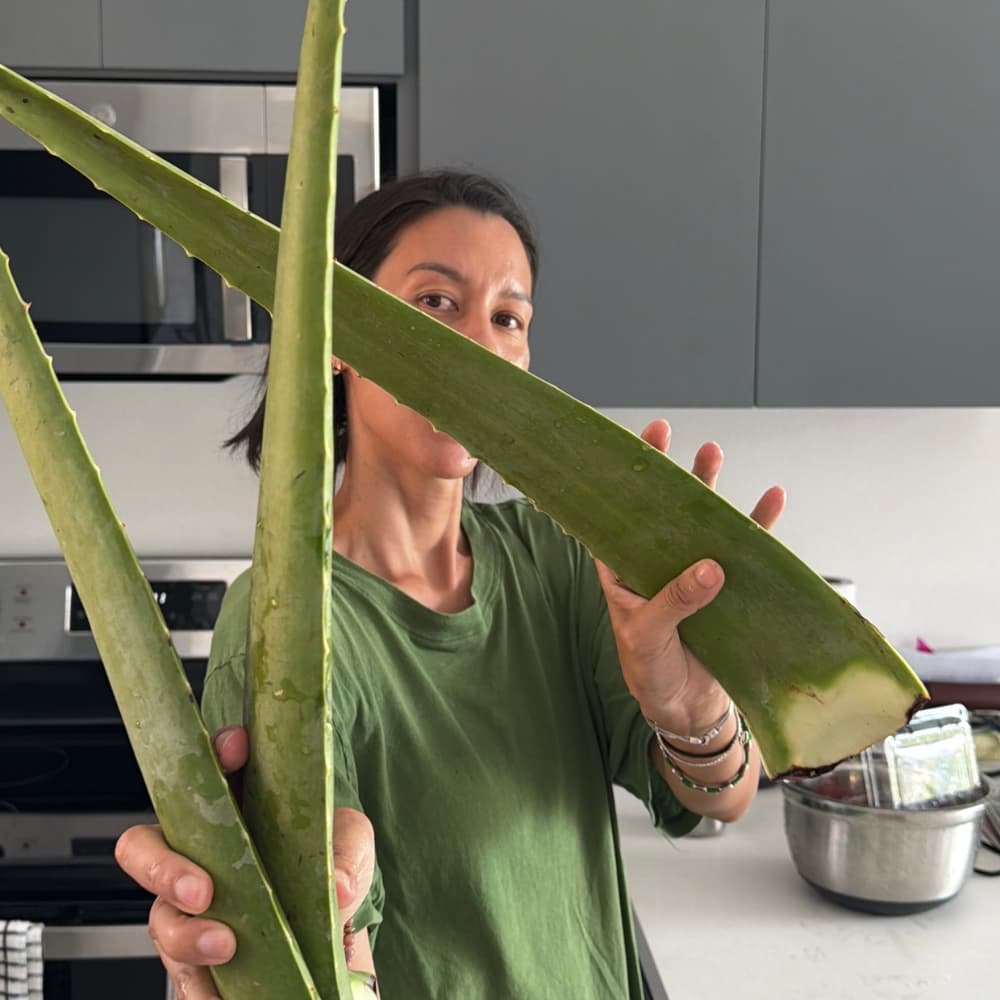
The green outer skin is the rind. Just inside it sits a thin yellow layer called the latex. Then in the middle is the clear, jelly-like inner gel. When people talk about the good stuff in aloe, they mean that inner gel - that slippery, translucent part.
The latex is where the trouble lives. It contains aloin (sometimes called barbaloin), an anthraquinone compound that acts as a potent laxative. In small accidental amounts it can cause cramping and loose bowels. The US National Center for Complementary and Integrative Health notes that non-decolourised whole-leaf aloe extract has been linked to cancer risk in rats, and there are reports of liver injury tied to oral aloe latex. The International Aloe Science Council sets a limit of under 10 parts per million of aloin for consumable aloe products (properly purified decolourised juice comes in far lower than that).
So the golden rule with aloe vera juice is simple. Prep the inner gel after you thoroughly remove the latex. That means either carefully prepared fresh gel with the yellow layer drained and rinsed away, or a reputable commercial brand labelled decolourised, purified or aloin-free. You guys already know which one I prefer!
The health benefits people drink aloe vera juice for
Aloe is definitely trending at the moment, and yes, I'm a fan. But what claims are actually substantiated?
Hydration with a bit extra.
The pure inner gel is mostly water, low in calories and naturally low in sugar, and it carries minerals like calcium, potassium, sodium and magnesium. One thing worth mentioning though, that ‘low sugar’ only holds for the plain gel. A lot of bottled aloe vera drinks have added sugar, juice concentrate or sweeteners, so the bottle on the supermarket shelf can be a very different thing from a glass you made yourself. Read the label and make an informed choice.
As a way to get fluids in without a sugar hit, plain aloe is a reasonable swap, and hydrated skin is built from the outside as much as the inside, which is the whole point of Hydration and Skin Health: Why Drinking Water Isn’t Enough.
Gentle digestive comfort and gut health.
This is the main reason people reach for it. Many people drink aloe vera juice for gut health, and there is some early evidence to back that up. The gel’s polysaccharides can act like a prebiotic, feeding the friendly bacteria in your gut and helping support a healthy, diverse microbiome, and some small studies have reported less abdominal discomfort and bloating in people with IBS-type symptoms.
A flow-on to skin.
Here is where it gets interesting for those with problem skin. Your gut and your skin talk to each other constantly, the gut-skin axis, so a prebiotic that supports a healthy, diverse gut microbiome may, in turn, have a flow-on effect for skin. There is genuine evidence behind this, even if it is still an emerging area. Aloe can lend skin a healing hand from the inside. I unpack the inside story properly in How Your Microbiome Shapes Your Skin: The Gut-Skin Axis Explained.
A nutrient-dense daily ritual.
For a lot of people the appeal is honestly just having a refreshing, low-sugar drink that feels nourishing.
Where I want to be careful is the over-promising. A daily aloe drink will not fix your gut or cure your eczema on its own. It can be a powerful piece of the puzzle when combined with other consistent gut loving habits.
The gut and skin are connected but no single drink is a shortcut to an eczema-free life - sorry! If your skin is flaring, the cause is usually a stack of triggers, and that is a different conversation I cover in What Causes Eczema Flare-Ups: The 10 Triggers I Wish I’d Known About Sooner.
The bigger claims you see online (and what the research really says)
I saw a reel claiming aloe vera ‘boosts stem cell production by 400%’. I went looking, because if that were real I would want to drink more than a glass a day. Sorry to disappoint, I could not find any research behind that 400% figure.
That doesn't mean aloe vera isn't backed by real science, it just means the real story is more measured than the viral TikTok version. A study on aloe sterols (plant compounds in the gel) found that in a dish, they prompted human skin cells called fibroblasts to make more collagen and hyaluronic acid, roughly double the collagen and about one and a half times the hyaluronic acid. A clear winner for skin barrier health.
That is genuinely interesting, but two things matter. It was an ‘in vitro’ study, meaning cells in a lab, not people drinking juice. And it is about fibroblasts, the skin’s own builder cells, not stem cells.
My aloe vera juice recipe

Start with a fresh, mature Aloe barbadensis Miller leaf. There are over 500 species of aloe and not all of them have been studied and deemed safe for human consumption.
Slice off the spiky edges and any 'white leaf' near the bottom of the cut stem. Stand the cut leaf upright in a tall glass or jug for 20 to 25 minutes so the yellow latex drains out. Some people like to stand it in water. Both methods work!
*Don’t skip this, it is the single most important step that removes the toxic aloin we touched on earlier.*
Trim away all of the green skin and that yellow layer until you are left with only the clear inner gel. Give the gel a good rinse under cool water to wash off any last bitterness and latex residue or even better, let it soak in filtered water for another 10 minutes before draining.
From there you scoop the clear gel into a blender with water and whatever else you want to add, a squeeze of lemon and a little honey works nicely. Lemon's are high in histamines though, so skip them if you're histamine sensitive.
Blend, strain if you like it smooth, and keep it in an airtight container in the fridge for no more than four to five days.
Start small. A modest glass is plenty while you see how your body responds. I also prefer to dilute mine by mixing it with water.
More is not better with aloe.
If you would rather see it than read it, I filmed the whole thing start to finish. Watch how I make my aloe vera juice on Instagram.
Who should skip aloe vera juice
I am a skin nerd, not a doctor or a dietitian, so please treat this as a prompt to check with a professional rather than the final word.
Aloe vera juice is not recommended in pregnancy, because it may stimulate uterine contractions, and it is best avoided while breastfeeding, since some compounds can pass to the baby.
If you have kidney disease, talk to your GP first.
Aloe can also interact with some medications. It may push blood sugar lower if you are on diabetes medication, and it can lower potassium, which matters if you take diuretics (water pills) or a heart medication called digoxin. If you are on blood thinners, check before making it a daily habit.
There is also a kidney angle worth knowing, and it is another reason the latex is the villain of this story. High doses of aloe latex have been linked to kidney problems, including acute kidney injury, and medicines regulators have logged kidney-related reactions to some oral aloe products.
This is about the latex and large amounts, not a sensible glass of properly prepared inner gel, but it is exactly why I stress draining, rinsing and soaking as essential prep steps. If you have any kidney condition, treat aloe as a doctor question, not a given wellness trend.
For most healthy adults, a modest amount of properly prepared inner-gel juice is generally well tolerated.
Aloe vera for your skin: the skin benefits
This is the side of aloe I know best, and the evidence for the skin benefits of aloe vera is friendlier than the drinking research.
There is good evidence that aloe vera gel is an effective moisturiser. It works as a humectant, which means it attracts and holds water in the top layer of the skin.
That extra water can ease the tight, parched feeling that sensitive and eczema-prone skin knows all too well. Aloe is also cooling and soothing, which is why people reach for it after sun or on hot, itchy days.
This is exactly why I included aloe vera in Every Day, Everywhere, a gentle face and body wash. Aloe is hydrating and soothing, it sits beautifully in a fragrance-free, sulphate-free wash, and it leaves skin feeling comfortable rather than stripped.
For me, that is aloe at its best, doing a quiet, supporting job inside a gentle routine rather than being asked to carry the whole thing.
A small number of people also find aloe itself irritating, so the golden rule applies here too, patch test, always, especially on reactive skin. I walk through how to do that in Sensitive Skin and Eczema: Common Irritants and How to Build a Skin-Friendly Routine.
How I actually use aloe
In my own house, aloe shows up in two places and neither of them is dramatic.
On skin, it is part of the wash rather than a standalone treatment. We use Every Day, Everywhere (a gentle face and body wash) to cleanse, then seal everything in with a moisturiser while the skin is still damp.
Aloe pulls water in, the moisturiser keeps it there. Water-based first, oil-based on top, that is the order that works.
As a drink, I treat aloe vera juice as an daily ritual, made from inner gel, carefully prepared, and never as a stand-in for actual food or medical care.
I live somewhere that has an abundance of quality, fresh aloe, so for me, maxing out at a glass a day is doable, but even a small glass every now and then as part of a balanced diet will do your body some good. If you are using diet to support your skin, a tracker beats guesswork. Pair this with the Skin-ED Food Diary (coming soon, I am putting the finishing touches on it) and you will spot your own patterns far faster than any blog can tell you.
Further reading (the guides that helped me figure this out)
Aloe Vera: Usefulness and Safety, NCCIH.The clearest plain-English rundown of what aloe can and can’t do, and the latex safety warnings I keep coming back to.
Aloe vera and the skin, DermNet. A dermatology resource on aloe as a moisturiser, including the honest note that there is no direct eczema trial evidence.
Aloe, Mayo Clinic. Good on the oral safety side, including medication interactions and who should avoid it.
Toxicologic assessment of decolorized whole leaf aloe vera juice, NIH. The science behind why decolourised, aloin-removed juice is the version to look for.
Aloe vera for treating acute and chronic wounds, NIH. A wider look at the topical research, useful for understanding aloe’s soothing reputation and its limits.
Effects of plant sterols derived from Aloe vera gel on human dermal fibroblasts, Clinical, Cosmetic and Investigational Dermatology. The actual study behind the collagen and hyaluronic acid claims, so you can see what the research says versus what the reels say.
One last thing
Aloe is one of those ingredients that gets sold as a cure-all, and I think that does it a disservice. It is a genuinely beneficial drink when it is made from the right part of the plant, and a soothing and hydrating ingredient on skin. It is not a treatment, it is not a shortcut and it is not for everyone. Be patient with your skin and kind to yourself, and don’t expect any one thing, aloe included, to do all the work.
I made Salvida so that I had products I could trust to use on my own family, and aloe vera earned its spot in Every Day, Everywhere for exactly that reason, gentle, fragrance-free and steroid-free.
If you have a question this article didn’t answer, reach out. I read every email and DM.
Jacqui
FAQs
Read more

The short answer Your gut microbiome and your skin are in constant conversation. The trillions of bacteria, fungi and other microbes living in your gut help train your immune system, calm inflammat...

Putting zinc oxide on your face overnight, the trend some people call ‘face basting’, means applying a thick layer of a zinc-rich product before bed so it sits on the skin all night. The reason it ...