The short answer
Stress and eczema are tightly linked. If you've noticed itch arriving the moment anxiety does, you're not imagining it. Your brain, nerves, stress hormones and the immune cells in your skin are wired together. Stress doesn't cause eczema, but it can switch on scratching within minutes and nudge a flare over the following days. In a lab study, people with eczema scratched more straight after a stress test while people without eczema didn't. In another study of almost 14,000 children, everyday stressors like starting a new school were linked to more eczema. The good news is that there are real tools that help. Habit reversal, cognitive behavioural therapy (CBT) and relaxation all have trial evidence behind them. Plus, keeping the skin barrier in good shape day to day means a stress-itch moment does less damage. Yes, consistency really is key!
Why I'm writing this
I'm Jacqui. I run Salvida, an Aussie skincare brand for sensitive and eczema-prone skin. I'm a mum of three and all three of my kids have eczema.
I started Salvida after my daughter's eczema spiralled out of control in Singapore. When I worked out her top triggers, stress was one of them, alongside dust mites and fragranced skincare. These days, when we fight, which happens more than I would like to admit (she's now 15 years old so well into that teenage stage), she will start manically scratching. The reaction is like someone has flicked on a light switch. It's immediate and this connection between her central nervous system and her skin still leaves me in awe.
And that's not to say that if you're stressed, you'll start itching. Everyone has their own triggers and how sensitive their body (and mind) is will vary from person to person. Personally, stress didn't flare my skin every single time. It set it off more often than not, especially when it piled up with other triggers like a cold winter or sticky humidity. It hit hardest when my skin was already compromised and not in check. And stress didn't always mean a flare. Often it just meant itch. When my barrier was in good shape, that itch usually passed. When it wasn't, the scratching often escalated into a flare.
Plenty of you have told me the same thing, often with a little apology attached. You're not making it up. I wrote about the everyday calm side of this in Glimmers, Stress and Sensitive Skin. This article goes deeper into the why and into what the research says actually helps.

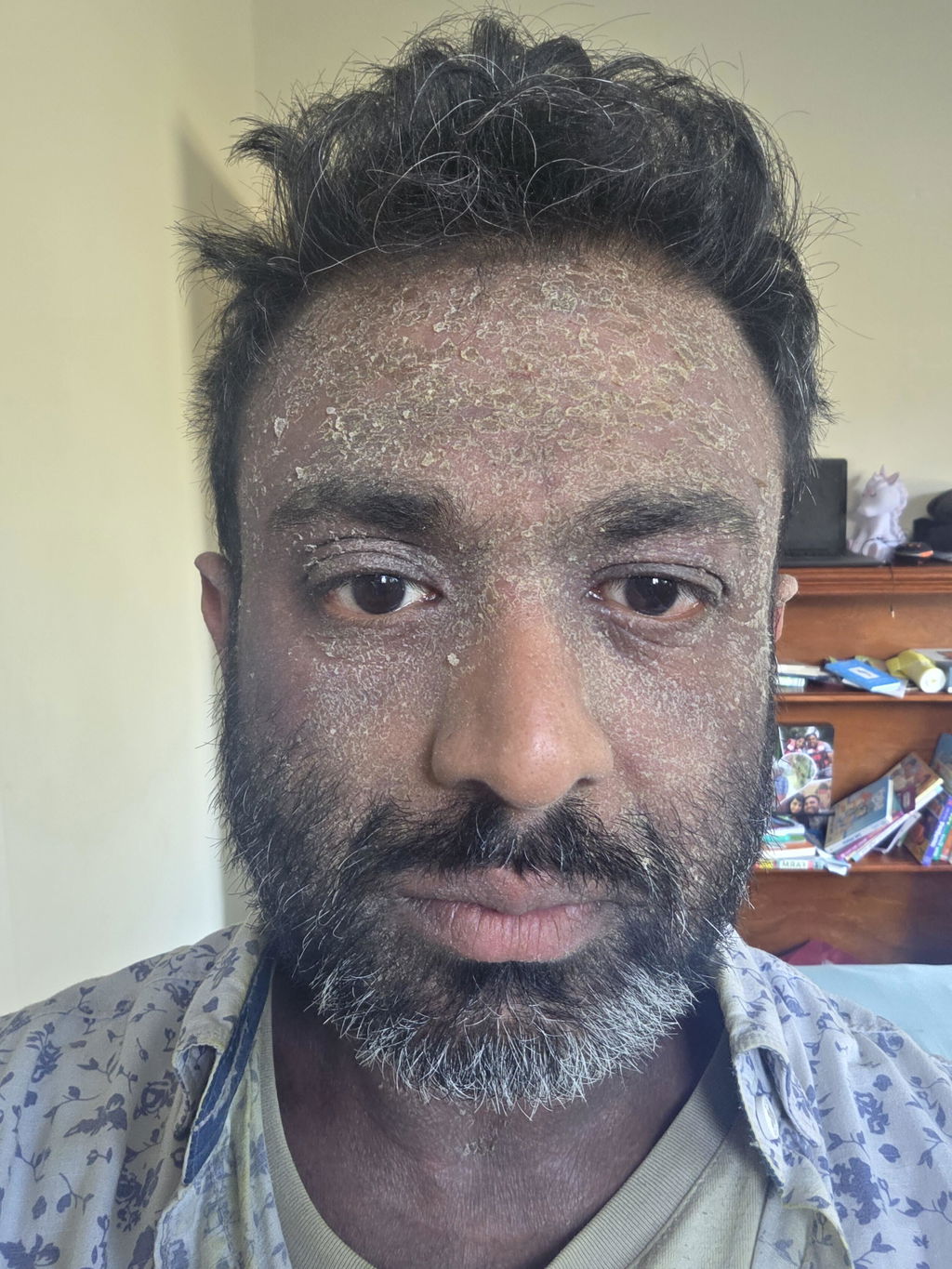
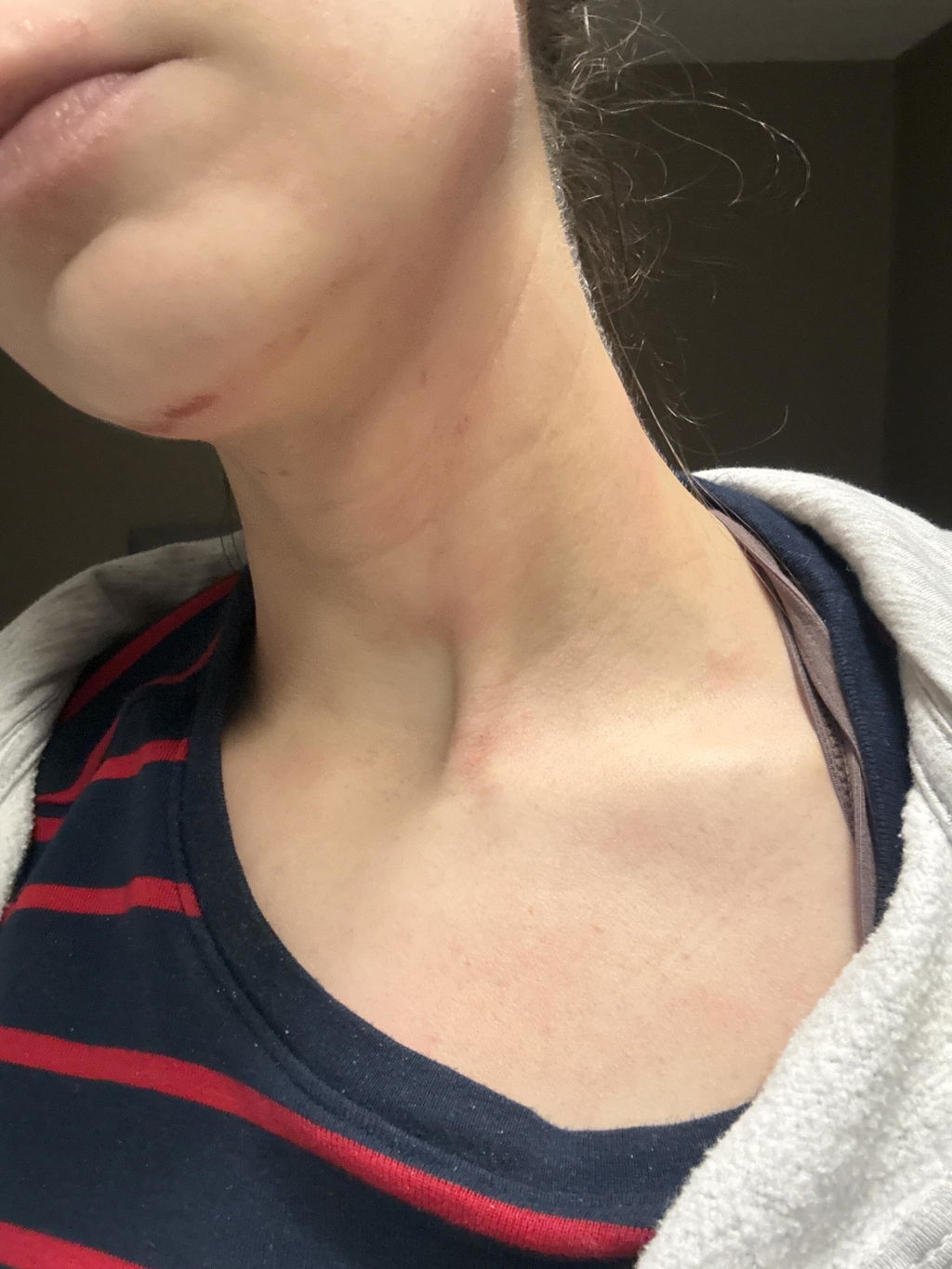
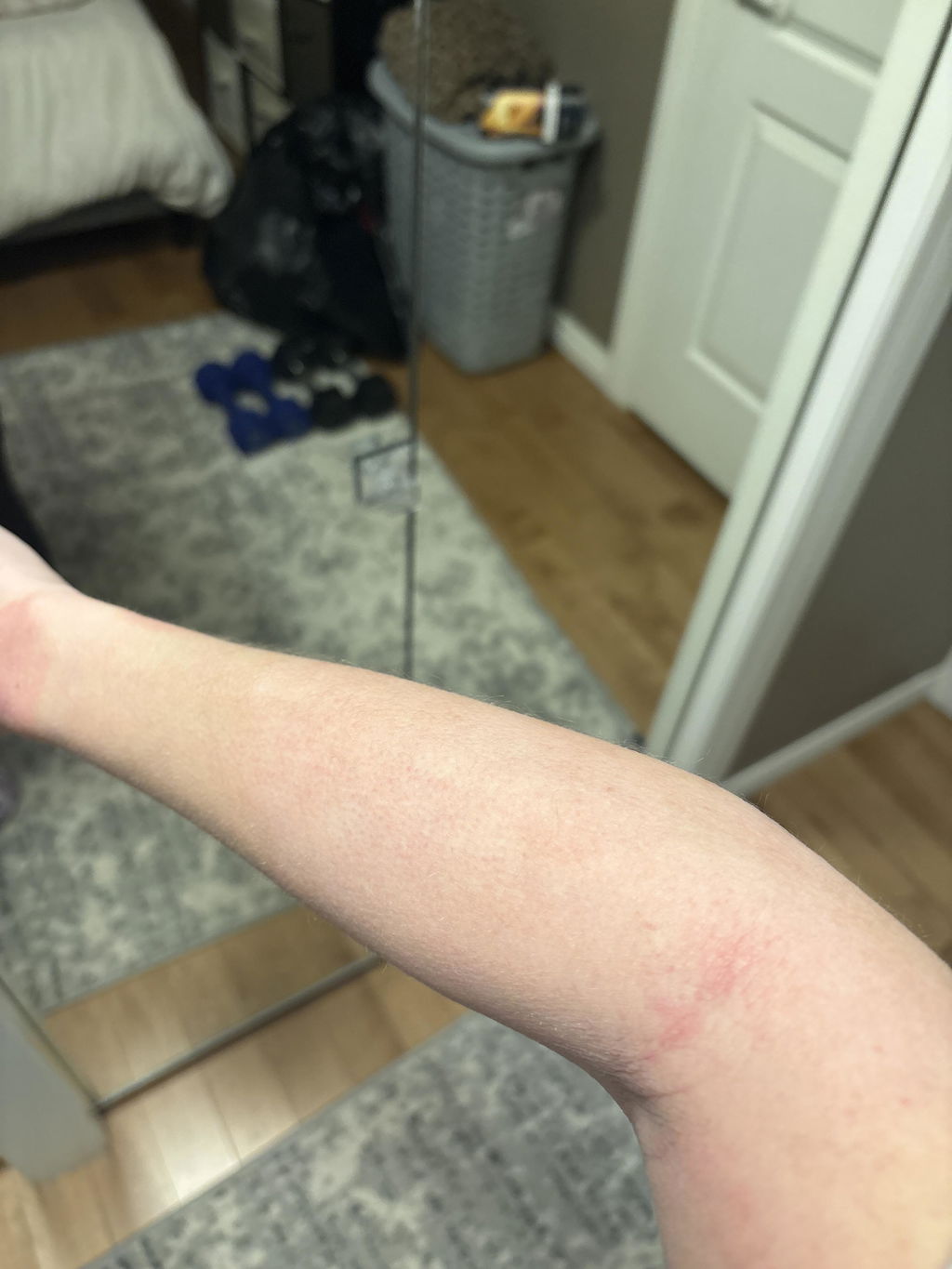
Photo: one of my daughter's milder flares in Singapore.
Is stress itch real or am I imagining it?
You're not imagining it. A few studies capture exactly what so many families describe.
In a 2019 study in the British Journal of Dermatology, Mochizuki and colleagues put adults with and without eczema through a standard stress test, which involves giving a speech and doing mental arithmetic in front of an audience. Afterwards, the people with eczema scratched noticeably more, often at spots away from where itch had been tested. The people without eczema didn't change. Stress seemed to switch on scratching itself.
A 2025 study in the Journal of Investigative Dermatology followed 13,972 UK children. Abuabara and colleagues found more stressful life events went along with more eczema activity. The link was modest overall, but stronger for moderate to severe eczema. It was driven by ordinary events that felt big to the child, like starting a new school or a new sibling arriving.
There's even a study showing how much the brain is involved. In 2011, Papoiu and colleagues found people with eczema itched and scratched more just from watching videos of other people scratching. If itch can start from a video, it makes sense that it can start from a worry.
What happens in your body when stress hits your skin?
Think of your body as having an alarm system with two main wires.
The first is the HPA axis, short for hypothalamic-pituitary-adrenal axis. It's the chain of signals running from your brain to your adrenal glands that releases cortisol, your main stress hormone. The second is your sympathetic nervous system, the fast "fight or flight" side that releases adrenaline and noradrenaline.
A 2017 review by Lin and colleagues explains that your skin runs its own mini version of this stress system. Skin cells can make stress hormones themselves and they carry receptors to respond to them. So your skin isn't just on the receiving end of stress. It takes part.
Stress raises cortisol. As I wrote in What Causes Eczema Flare-Ups?, it suppresses the immune system in some ways and stirs it up in others. The research adds a twist. The same review notes that people with eczema often have a smaller cortisol rise under stress than you'd expect. Cortisol normally helps settle the immune system, so a smaller rise can mean less of that built-in braking.
Stress also affects the barrier itself. In a 2001 study, Garg and colleagues found students' skin barriers recovered more slowly during exam weeks than during holidays. A slower barrier means irritants get in more easily and moisture escapes faster.

How does stress turn into itch and why does it keep going?
Here's the chain, step by step. When your brain senses a threat, whether it's a looming deadline or a tricky conversation, it releases corticotropin-releasing hormone (CRH). That starts the HPA axis and the fight or flight response.
In your skin, tiny nerve endings sit right next to mast cells, the immune cells that store histamine and other itch signals. Under stress, those nerves release messengers called neuropeptides, such as substance P and CGRP (calcitonin gene-related peptide). A 2012 review by Suárez and colleagues describes how mast cells respond to these messengers and to stress hormones. A 2012 review by Hall and colleagues adds that mast cells carry receptors for CRH itself. So the stress signal reaches the mast cell from two directions. It releases its itch signals, the itch nerves fire and you scratch.
Why would your body do this? The stress response is built to get you ready for danger. For early humans, danger often meant a wound or a bite. A 2014 review by Dhabhar describes how short bursts of stress move immune cells into the skin so it's primed to defend itself. Itch is part of that same protective kit. It's the alarm that tells you to brush off a bug or an irritant. In eczema-prone skin, with a weaker barrier and more sensitive nerves, that useful alarm goes off far too easily.
One honest nuance: much of this comes from reviews and lab research. A small 2007 biopsy study by Lonne-Rahm and colleagues found more mast cells in stressed eczema skin but no clear difference in substance P or CGRP nerve fibres. Scientists are still mapping the details.
Then there's why it keeps going. Scratching feels good (like, really good!) for a moment because it briefly overrides the itch signal. But it damages the barrier and damaged skin cells release alarm messengers that switch itch nerves on again. A 2018 review by Mack and Kim calls this a neuroimmune loop. Stress speeds it up in two ways. It makes mast cells and nerves quicker to fire, so the urge arrives sooner. It also slows barrier recovery, as the Garg study showed, so the damage from each scratch lasts longer.
Why do some people itch from almost nothing?
Over time, nerves in eczema-prone skin can become more sensitive. Researchers call this neural sensitisation. A 2023 review by Mahmoud and colleagues in Frontiers in Molecular Neuroscience explains two related effects:
-
alloknesis, when something that shouldn't itch, like a light touch or a woolly jumper, feels itchy
-
hyperknesis, when something mildly itchy feels intensely itchy
The same review notes that in eczema, things that would feel slightly painful to other people can register as itch. This is a big part of why the itch can feel automatic. It's also my best guess for why my daughter goes straight for her inner elbows. Those creases are classic eczema spots, so they're likely the most sensitised skin she has. I couldn't find a study that tests this, so take it as my reasoning rather than a proven fact.
Why do kids scratch when they're anxious?
Children have fewer ways to name big feelings, so the body often gets there first. Scratching can become a habit that fires before the child even notices.
The link runs both ways. In a 2021 study of 11,181 UK children published in JAMA Dermatology, Kern and colleagues found severe eczema was associated with roughly twice the odds of depressive and anxious symptoms. Even milder eczema was linked to more emotional symptoms from about age four. Poor sleep explained part of the connection.

What actually helps calm stress itch?
"Just keep calm" is possibly the worst advice anyone can give a person who is anxious, stressed or angry. Most people have been on the receiving end of it. Calm isn't a switch. What helps is having tools that work with your body rather than against it. Here's how the evidence stacks up.
| Tool |
What it involves |
Strength of evidence |
| Habit reversal |
Noticing the urge to scratch, then doing a "competing" action instead, like pressing or clenching |
Several small randomised controlled trials (RCTs) in adults and one in children, plus reviews |
| CBT |
A structured talking therapy that helps you notice and change thought-and-reaction loops |
One strong online RCT in adults |
| Relaxation and stress management |
Guided relaxation, autogenic training and stress-management programs |
Small trials and reviews, mixed quality |
| Breath work and glimmers |
Techniques like box breathing or a long, slow exhale, plus small calming moments through the day |
No eczema-specific trials yet; a useful everyday tool |
| ITSAN's safe scratch plan |
Cold packs, mindful scratching, busy hands, cotton gloves at night |
Lived-experience tips, not trial-tested |
| A proactive barrier care routine |
A gentle daily barrier care routine that keeps skin in good shape before stress hits |
Practical support to stay ahead of a flare and settle angry skin |
Habit reversal has the most research behind it. In trials from 1986 and 1989, Melin, Norén and colleagues found adults who swapped scratching for a competing action improved more than those using creams alone. A 2018 trial of 39 children by Norén and colleagues saw the same pattern. A 2023 review by Hua and colleagues found psychological approaches helped in 10 of 11 studies. CBT is a structured talking therapy that helps you notice and change thought-and-reaction loops. In a 2021 trial, Hedman-Lagerlöf and colleagues found a 12-week online CBT program built around mindfulness improved eczema symptoms, itch, stress and sleep. Relaxation programs helped too, according to a 2007 meta-analysis by Chida and colleagues and a Cochrane review by Ersser and colleagues, although many studies were small.
Breath work and glimmers are the tools I reach for myself. Box breathing means breathing in for four counts, holding for four, breathing out for four and holding for four. Another option is cyclic sighing, which means two short breaths in through the nose followed by a long, slow breath out through the mouth. In a 2023 study of adults without eczema, Balban and colleagues found five minutes a day of cyclic sighing lifted mood more than mindfulness meditation. I couldn't find a trial testing breath work on its own for eczema itch, so think of it as a way out of alarm mode rather than an itch fix.
If you'd like to try habit reversal or CBT properly, a practitioner you trust can guide you. That might be your GP, a dermatologist, a naturopath or a psychologist.
How do you calm a stress itch in the moment?
The itch-calming tips I share across Skin-ED stay the same here, because itch is itch whatever starts it. Many of them come from the "safe scratch plan" in the International Topical Steroid Awareness Network (ITSAN) coping guide. It was written for topical steroid withdrawal but suits any itch that arrives faster than you can think. ITSAN is clear these are shared lived-experience tips rather than medical advice. The habit reversal research above backs up the same swap idea.
-
Go cold. ITSAN suggests ice or an ice pack on the itchy spot, a cool bath, rinsing your hands in cool water or a cold washcloth. This one is close to my heart. In Singapore, I put my daughter in a cold bath to break her itch-scratch cycle.
-
Scratch mindfully. If you can't stop, make each stroke gentler until you do. ITSAN also suggests counting to 60 to see if you can hold off for a minute.
-
Give your hands a job. Sit on your hands, cross your arms and tuck your hands under your armpits or keep them busy with a book, a game or something to fiddle with.
-
Have an anti-scratch mantra and a "wellness buddy" who can gently let you know when you've been scratching for a while.
-
Protect skin overnight. Cotton gloves or soft cotton sleepwear help limit damage from scratching in your sleep.

The skincare side fits alongside this:
-
Stay ahead of it. The best stress-itch plan starts before the stress does. A gentle daily routine keeps skin less reactive, so a stress-itch moment has less to work with.
-
A cool mist. Barrier Reset Spray is a cool, fragrance-free hypochlorous acid mist that visibly calms redness and refreshes skin that feels hot. A quick spritz also gives hands something to do other than scratch. It's a practical swap rather than a trial-tested one, but it fits ITSAN's "go cold" tip.
-
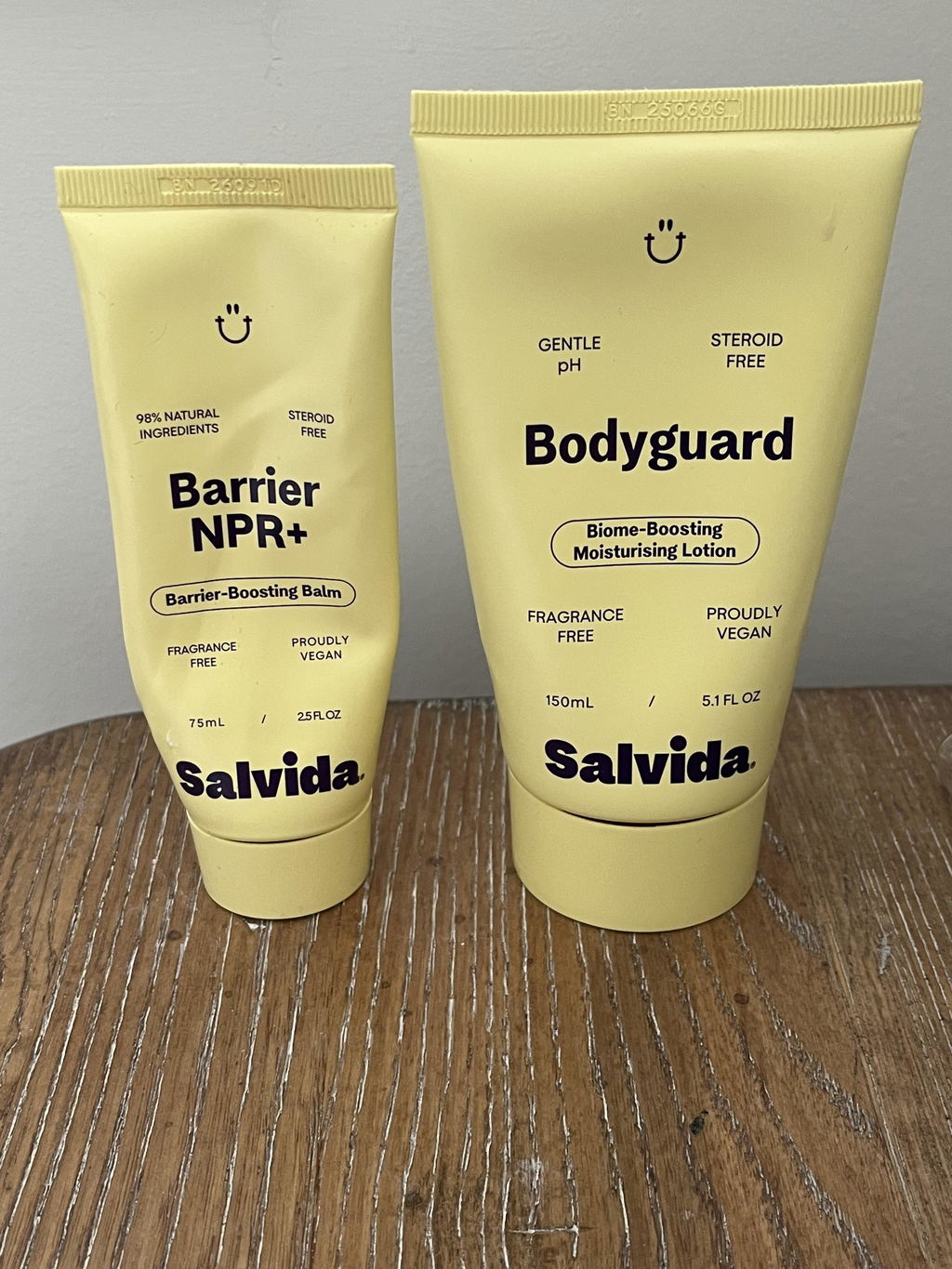
A soothing seal. A dab of a barrier support balm like Barrier NPR+, which uses colloidal oatmeal, helps calm itchy, irritated skin. The balm also physically covers the spot so you're less tempted to scratch it raw. It's the same way I describe it for mozzie bites in The many uses of a barrier balm.
For kids, the same ideas work with a little extra gentleness:
-
Notice without scolding. "I can see your elbows are itchy" lands far better than "stop scratching". ITSAN makes a similar point. Most people don't want to hear "don't scratch".
-
Offer a swap. Press the spot, squeeze a stress ball, pat the skin or hold an ice pack or cool cloth against it.
-
Name the feeling. "Are you feeling worried about tomorrow?" can take the heat out of both the worry and the itch.
-
Keep nails short so any scratching does less damage.
-
Plan for known stress points like the first week of school, exams or a big change at home. My Back to School and Eczema guide covers the school side.
What skincare routine helps with stress itch?
Skincare doesn't switch off stress. What it can do is keep your skin in better shape before a stress-itch moment arrives. A barrier that's already well looked after is less compromised, less angry and less likely to pick up an infection when it does get scratched.
That's why I'd focus on a steady daily routine rather than reaching for products only in a crisis:
-
Every Day, Everywhere is my soap-free, fragrance-free face and body wash with a skin-friendly pH of around 5.5, so washing doesn't add extra irritation.
-
Bodyguard is my lightweight lotion, clinically tested to provide 8+ hours of hydration with a single application. Its pre and postbiotic complex is there to support your skin's microbiome. It's my pick for maintenance days.
-
Barrier NPR+ is my water-free, zinc-rich balm. Colloidal oatmeal gives it a calming, soothing feel. It's designed to visibly reduce redness and soothe irritation and itching caused by dryness. It's my pick when skin is flaring. It doesn't hydrate on its own, so within three minutes of getting out of the shower, smooth it over Bodyguard or still-damp skin to help lock that moisture in.
-
Barrier Reset Spray is my 150 ppm hypochlorous acid mist. Hypochlorous acid is a molecule your own immune cells make. I keep it for its own moments: in the morning, before bed or whenever skin feels hot, tight or itchy. Mist it onto dry skin, give it a few minutes to dry, then follow with Bodyguard or Barrier NPR+. There's nothing to rinse off.
Add lukewarm rather than hot showers and soft cotton against the creases. That's the same barrier-first approach I describe in Sensitive Skin and Eczema: Common Irritants. For the stress-itch moment itself, the cool mist and soothing seal above do the work.
When should you get extra help?
If scratching is wrecking sleep, if anxiety or low mood are taking over or if you feel stuck in the cycle, talk to a practitioner you trust. Habit reversal and CBT work best with someone guiding you.
Get prompt medical help for signs of infection, such as weeping, honey-coloured crusts, spreading redness, pain or fever. Clusters of painful, punched-out sores or blisters can be eczema herpeticum, which DermNet describes as a dermatological emergency.
Further reading
These helped me figure this out. I'm a founder and an eczema mum, not a clinician, so please see the links as reading rather than personal medical advice.
-
Mochizuki et al. 2019, British Journal of Dermatology: acute stress and scratching in eczema.
-
Abuabara et al. 2025, Journal of Investigative Dermatology: stressful life events and eczema activity in 13,972 children.
-
Lin et al. 2017, International Journal of Molecular Sciences (PMC): stress, the HPA axis and eczema.
-
Dhabhar 2014, Immunologic Research: why short-term stress primes the immune system.
-
Mack and Kim 2018, Trends in Immunology (PMC): the itch-scratch cycle.
-
Mahmoud et al. 2023, Frontiers in Molecular Neuroscience: nerve sensitisation in chronic itch.
-
Balban et al. 2023, Cell Reports Medicine: brief daily breath work and mood.
-
Norén et al. 2018, British Journal of Dermatology: habit reversal in children with eczema.
-
Hedman-Lagerlöf et al. 2021, JAMA Dermatology (PMC): online CBT for eczema.
-
Kern et al. 2021, JAMA Dermatology (PMC): eczema and mental health across childhood.
-
Langan et al. 2006, British Journal of Dermatology: a diary study of trigger factors and scratching in children.
-
ITSAN: Coping with TSW: community lived-experience itch tips, including the safe scratch plan (not peer reviewed).
What I'd read next
For the everyday calm side of this, read Glimmers, Stress and Sensitive Skin: Why Small Moments Matter for Eczema.
If you want to find your own top triggers, What Causes Eczema Flare-Ups? The 10 Triggers I Wish I'd Known About Sooner walks through how I found my daughter's.
And for the emotional load that sits alongside all of this, read The Invisible Burden of Eczema.
One last thing
If you or your child scratch when stressed, it's not a character flaw and it's not in your imagination. It's a brain and skin that are deeply connected. Be gentle with yourself on the hard days. Look after the barrier on the easy days so it's ready for the hard ones. This isn't medical advice and it can't replace someone who can actually look at your skin.
I made Salvida so that I had products I could trust to use on my own family. It sits where the science meets gentler, more natural solutions. If you have a question about any of this, reach out at jacqui@salvida.au. I read every email and DM.
Jacqui